Crip Space-Time: The Math I Do Before Breakfast

Crip Space-Time: The Math I Do Before Breakfast
When I wake up, the first thing I see is how much urine I produced overnight. That number starts the clock. It tells me how much I can drink this morning, until my next catheterization. That one tells me how much I can drink before the next.
I pee on schedule, and I never drink more than I should. A cup of liquid, 250 ml, is all I can hold. I also choose my protein and fibre with care, because they shape how full I feel and how my digestive system behaves all day.
Then I count energy: how many transfers, how much effort to get through the day. A friend of mine was retiring, and I wanted to be at her party. That same night was parent-teacher night. I knew I wouldn't be in bed before 11 pm or midnight. So I woke up at 9 am instead of my usual 5 am training time, and I planned a late morning for the day after.
Nobody sees this math. Margaret Price (2024) gives it a name: crip spacetime. ("Crip" is a word disabled communities reclaimed.) For disabled people, space, time, cost, and accompaniment can't be pulled apart. Change one and the other three move. And a system that offers a fixed "accommodation" assumes a disability that stays the same. Mine starts each day with a new number. I've written about air travel and the right to pee. This is the everyday version.
Space. Space is more than a location. Price notes that people don't perceive a space the same way, at the same moment, or at the same cost (p. 71). Toilets can be accessible, yet not, because a grab bar is missing. Conference rooms can have carpet. In Halifax, my room was on the fourth floor. Before the trip, my occupational therapist and I had worked through solutions for my first flight, and my dad had searched for a hotel. We thought we'd covered it. Then the elevator broke, and the room stopped being mine. Price calls lack of access "appalling and ordinary" (p. 49). That elevator was both.
Time. Everything slows down. A transfer into my car takes 15 minutes. A bathroom visit takes at least 20, and if the only accessible one is occupied, I wait. When I have to go, I have to go. I can't hold it.
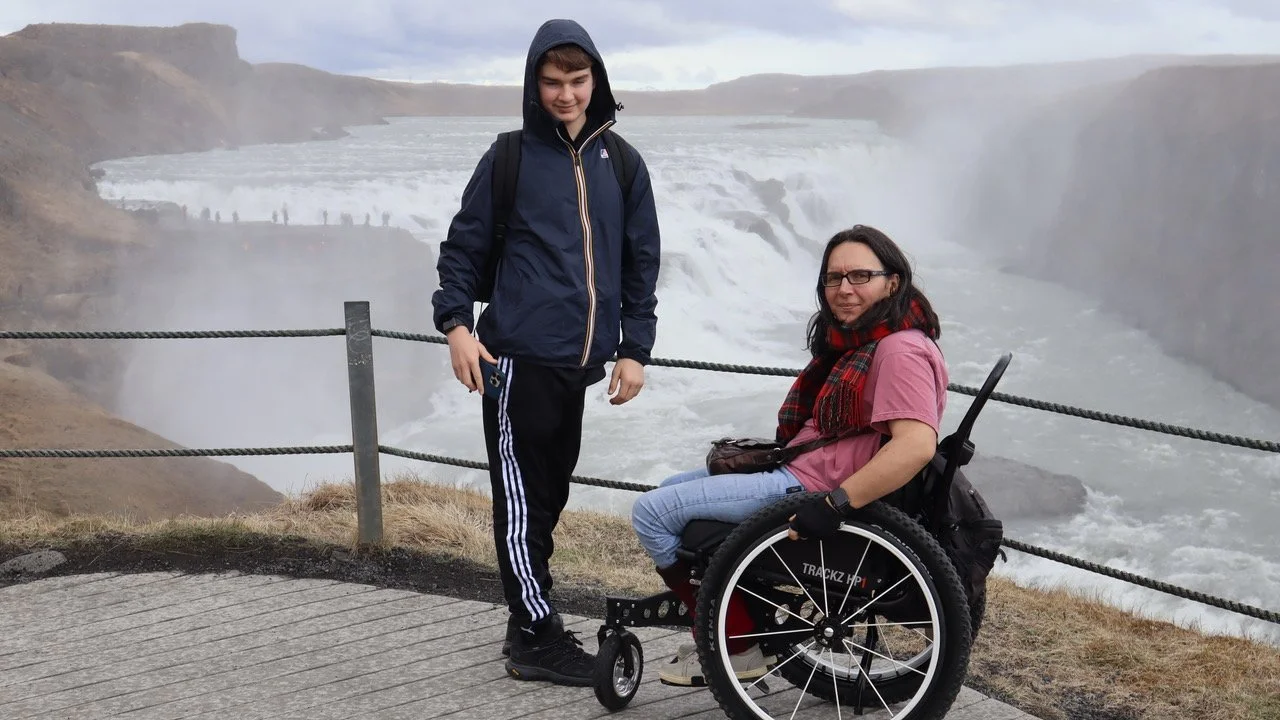
Leaving my house takes a few more minutes than it does for my son, who just walks down the stairs. A shower, a morning routine: several hours. Time is often not my own. Ellen Samuels (2017) quotes Alison Kafer's idea that crip time "bends the clock to meet disabled bodies and minds." Samuels also writes about what that costs: grief and loss. Both are true.
Cost. Lack of access has a price. Not being able to climb the mountain with my nieces and nephews has an emotional cost. Being part of the rafting group had a financial one: three men came along for my safety. It was necessary, and it was costly. Then there's the mental load of over-planning. Emens (2021) calls it disability admin: the invisible administrative work of being disabled, such as researching, calling ahead, arranging, and checking. Price also describes the personal triage of deciding when to fight and when to cut your losses (p. 120).
Accompaniment. Nobody navigates crip spacetime alone. In Halifax, I didn't know what to do. My colleague did. She told the manager to find us accessible rooms elsewhere, at the same price, with compensation. Within the hour, we had what we needed.
My sister named something else I hadn't seen. She calls my slowness a blessing. On mornings with my long routine, as I call it, everyone stays put, relaxes, and stays in pyjamas. Nobody runs after the clock.
That's the yes and yet. Yes, the math is exhausting. And yet the slowness gives my family something the clock never does.
Price points to collective accountability (p. 103): access isn't one person's work. Two things worth doing:
Ask before, not after. Price calls this access priming: anticipating an access need before it becomes a problem. Planning a dinner, a trip, or a meeting? Ask, "What should we look for when booking?"
Describe, don't label. "Accessible" tells me almost nothing. Tell me about the grab bars, the carpet, whether the elevator works. Then I can do my math before I arrive, not at the door.
References
Emens, E. F. (2021). Disability admin: The invisible costs of being disabled. Minnesota Law Review, 105(5), 2329. https://doi.org/10.24926/265535.4214
Price, M. (2024). Crip spacetime: Access, failure, and accountability in academic life. Duke University Press.
Samuels, E. (2017). Six ways of looking at crip time. Disability Studies Quarterly, 37(3). https://doi.org/10.18061/dsq.v37i3.5824

written by
Marjorie Aunos, PhD., is an internationally renowned researcher, adjunct professor, clinical psychologist, and award-winning inspirational speaker from Montreal, Canada.
Recent Blog