Living a Rich Life

How to live a Rich Life as a Mom on Wheels
The water was still enough to mirror the mountains. I was in a kayak on a lake in Alberta, guided onto the water by Rocky Mountain Adaptive, and for a while I just sat there, not paddling, taking in a view I never expected — low, close to the surface, the peaks doubled in the reflection below.
Psychologists have long debated what makes a life good. Oishi and Westgate (2022) argue there isn't one answer, but three. A happy life is oriented toward pleasure — maximizing good moments, minimizing bad ones, living in the present. A meaningful life is oriented toward purpose — identifying your values and living in line with them. And a psychologically rich life is oriented toward experience — a variety of interesting, perspective-changing moments, not all of them pleasant, that leave you seeing the world differently than before.
My life has always had meaning at its center. I've worked with parents with disabilities for close to 28 years, and that work gave me purpose — a clear sense that what I did mattered. There were sparkles of the first dimension too, small epicurean joys scattered through a life mostly organized around purpose. But meaning was always the gravitational center.
Then I acquired my own disability, and meaning was the first thing I felt I'd lost. I couldn't keep up with everything I'd built my sense of purpose around, and for a while that felt like losing what had organized my whole life. It came back, eventually, in a different shape: being a disabled parent gave me a new, specific reason to advocate — not only for parents with disabilities in general, but from inside the experience myself. Meaning returned. But it didn't make me happy. I was purposeful again, and still not okay.
That's when I heard about the possibility of living a rich life. A rich life doesn't ask you to maximize good feelings or stay aligned with a mission. It asks you to stay curious. To notice when something is new, or strange, or hard, and treat that as material instead of a problem to solve.
Kayaking on that lake didn't need to be meaningful to count. It didn't need to make me happier than I already was. It needed only to be new — a way of moving through water and mountains I hadn't tried before, with the particular help it took to get me onto the water in the first place.
That's enough. Novelty and perspective change are the currency, not comfort.
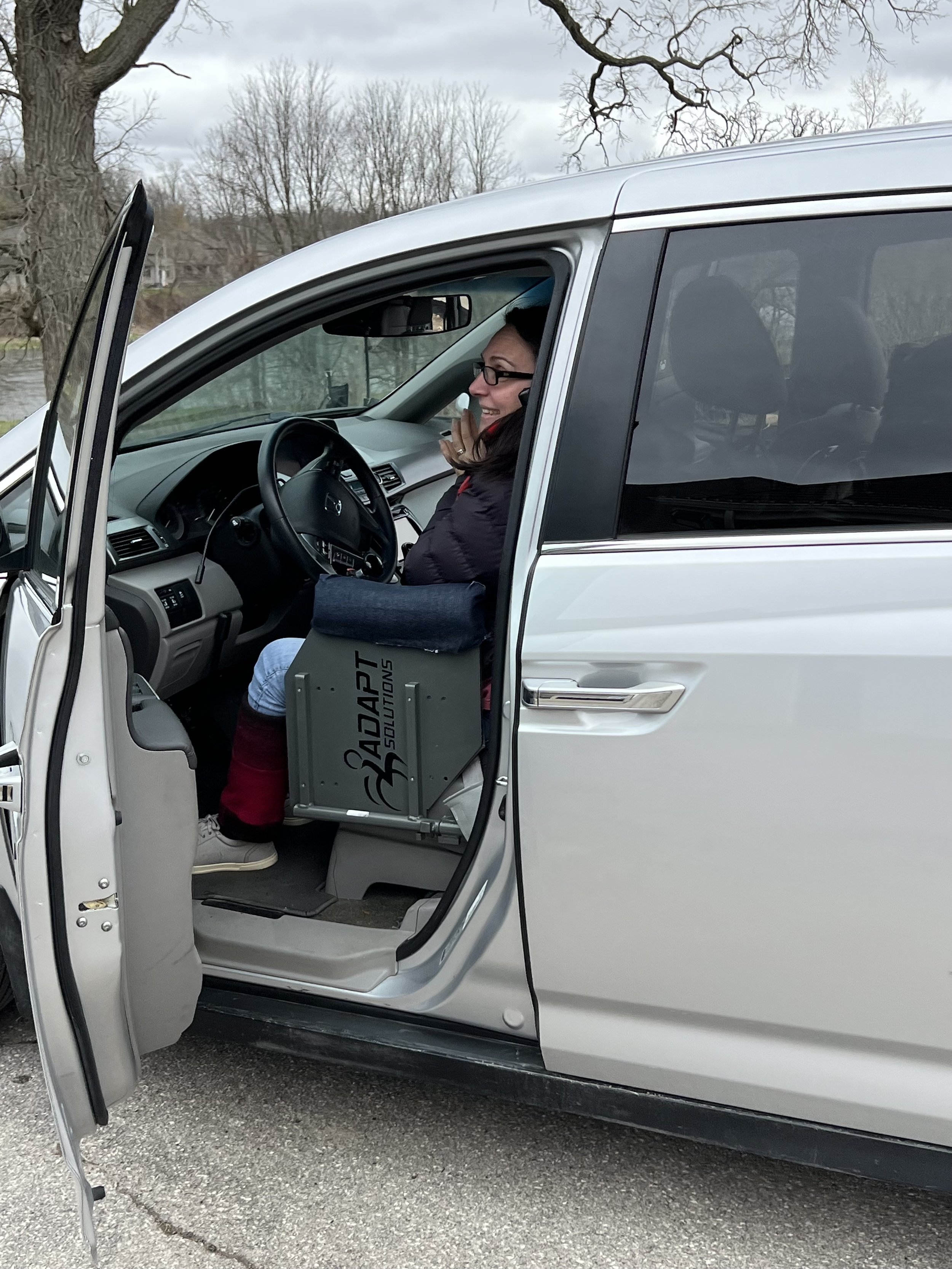
This is also where the hard parts stop being purely hard. A rich life doesn't sort experiences into good and bad the way a happy life does. It asks you to be curious about the difficult ones too — the frustration of new logistics, the vulnerability of trying something you might be bad at, the irony of ending up somewhere you never would have gone without the disability that got you there. I've learned to hold onto that irony rather than resent it. It's given me sports I wouldn't have tried and audiences I wouldn't have spoken to.
None of this replaces meaning or happiness. Oishi and Westgate's point isn't that richness is better — it's a separate, often neglected dimension. A full life probably draws on all three. I still care about purpose, and I still want good moments. But I no longer organize my life around only those two.
That afternoon, I focused on how I could use my back muscles and shoulder strength to move my paddle and get the most power. I became curious about how to kayak with a different body. That's what a rich life actually is: not a lesson learned, not a box checked, but a strange, ordinary afternoon, and a new understanding of how you do things.
So how do you do this, day to day?
Craving happy moments? Try going to:
A show
A spa
The movies
A good restaurant
If you are someone with a disability living in Quebec, check out:
Accessible shows, on Altergo's accessible culture calendar
Théâtre Hector-Charland, in L'Assomption
Craving meaning? Try:
Volunteering
Asking yourself what your most important values are — and how you can honour them a little more each day
Investing fully in your most important roles: at work, in your relationships
Craving a rich life? Try:
Anything you have never tried before
Go on an adventure, a road trip
Read a novel that transports you somewhere completely different
If you are someone with a disability, check out:
The Montreal Symphony Orchestra (OSM)
You don't have to choose just one of these three lives — you can aim for all three. But if you only try one thing this week, try something new. That might be where it starts.
***
Reference: Oishi, S., & Westgate, E. C. (2022). A psychologically rich life: Beyond happiness and meaning. Psychological Review, 129(4), 790–811. https://doi.org/10.1037/rev0000317

written by
Marjorie Aunos, PhD., is an internationally renowned researcher, adjunct professor, clinical psychologist, and award-winning inspirational speaker from Montreal, Canada.
Recent Blog