Beyond the Charts: Believing in your clients’ capacity
How a Physio's Belief Becomes Your Own
There's a moment in rehabilitation that doesn't show up in any chart: the moment a physiotherapist looks at what your body can no longer do, and decides — out loud or not — what it might still be capable of.
That belief matters more than we tend to say, and there's a name for it in the research: relation-inferred self-efficacy, or RISE. It's one part of a three-part model of belief in relationships built around performance and capacity (Lent & Lopez, 2002).
Self-efficacy: how much you believe in your own capacity.
Other-efficacy: how much you believe in your therapist's ability to help you.
RISE — talked about least, and I think matters most: your sense of how much your therapist believes in you.
That third belief isn't a soft feeling alongside the "real" clinical work — it's measurable and predicts outcomes. RISE and other-efficacy directly predict clients' own self-efficacy, which translates into more effort in session (Hill, Smith, Myers, & Feltz, 2022; Jackson, Dimmock, Taylor, & Hagger, 2012).
In plain terms: when a client feels believed in, they come to believe in themselves, and that belief shows up as effort.
This matters most when a person has the least evidence to draw on — early in rehab, before they've relearned anything, when their own sense of what's possible is still guesswork. That's precisely when a therapist's belief carries the most weight — it's standing in for evidence the client doesn't have yet.
This is where my own experience fits. I'm a paraplegic woman with a spinal cord injury at T2 — high enough that I have no functional access to my abdominal muscles. It's not just the abs: the intercostal muscles and most of the erector spinae below the injury are typically affected too. What's left, and what I rely on, sits above that line — my shoulders, and especially my latissimus dorsi, a muscle that runs low along the back but is controlled by nerves higher up, near the neck, which is why it still answers when so much else doesn't.
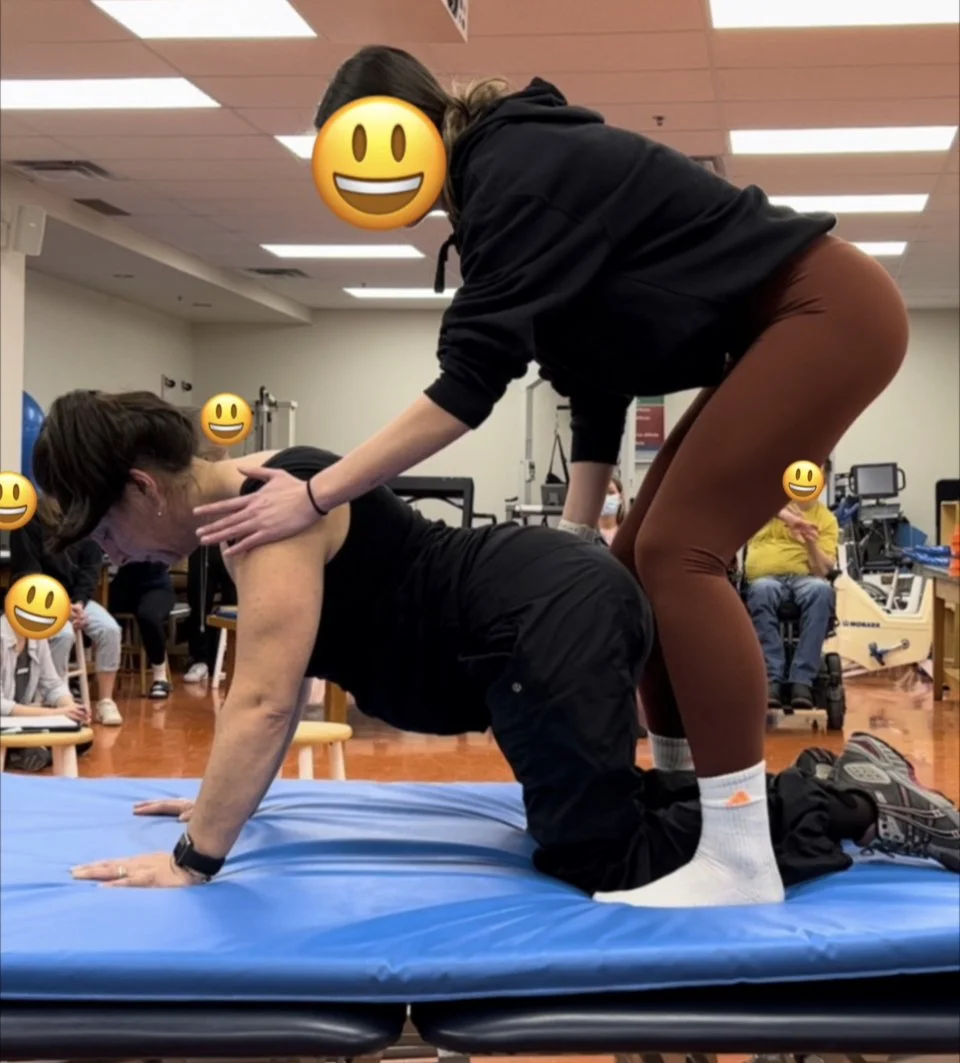
My first physio helped me into an all-fours position, years ago — something we did together, with him supporting my hips the whole time. He never told me I could hold it without him. So I didn't try. For years, the only time I went on all fours was in session, while he taught students — a demonstration, not something I thought was mine to attempt alone. I didn't realize what that might be costing me: better core control, real weight-bearing through my limbs, which affects bone density over time. It sat unused, not because my body couldn't do it, but because nobody had told me it was mine to try.
Then, with a different physio, one sentence changed everything. She'd barely helped me up when she said, almost offhand: "I hardly helped you. You did that all by yourself." That was it — not a new muscle, not a new technique, a sentence. It was the first time anyone had told me the capacity was already mine, not something we produced together. That's what let me try it alone, for the first time in years. I do it now every second day.
That's the RISE mechanism, almost too cleanly demonstrated: the exact same movement, physically possible the whole time, sat unused until someone said, out loud, that it already belonged to me.
What does this actually ask of physios in practice? Not just administering exercises — transmitting belief in a way the client can use. A clinician's expectation of what a patient can do becomes part of what the patient believes about themselves, and part of what they're willing to attempt next.
Two things worth trying, concretely:
Say the belief out loud, and be specific. Not "you've got this" — something closer to "I've seen this movement come back in bodies like yours before, and I think it's there in you too." Specificity is what makes it usable rather than generic encouragement.
Name the mechanism to the client, once. Tell them plainly that your confidence in their capacity is part of the treatment, not a bonus on top of it. Clients who understand why belief matters are more likely to actually let it in.
Letting clients know what you believe they're capable of builds both self-efficacy and a stronger therapeutic relationship (Jackson, Dimmock, Taylor, & Hagger, 2012).
***
On World Physiotherapy Day:
what you believe about your clients' capacity becomes their belief too, whether you say it out loud or not. That's not pressure — it's an invitation to take the belief part of the work as seriously as the biomechanics, because research says the two aren't separate.

written by
Marjorie Aunos, PhD., is an internationally renowned researcher, adjunct professor, clinical psychologist, and award-winning inspirational speaker from Montreal, Canada.
Recent Blog