Between the ocean and the elevator: Why I Never Stopped Traveling
Between the ocean and the elevator: Why I Never Stopped Traveling
Six months after my accident, I was supposed to be in Halifax for a conference. I first thought: how could I travel with a spinal cord injury? Is travelling now out of my reach? My parents and I decided otherwise. I needed to go so that I would know that my goals were still reachable, even if reaching them now meant more planning ahead, and enough flexibility, once there, to actually enjoy the ride.
The planning started early. My occupational therapist and I worked through solutions for my first flight. My dad searched for a hotel that could actually accommodate me. We thought we'd covered it.
On the second day, coming back from the conference, the hotel manager told us the elevator was broken. My room was on the fourth floor. I didn't know what to do — but my colleague, who had spent a lifetime watching her own mother advocate for her, took control. Advocating for greater accessibility was something she'd learned. She told the manager, plainly, that he had an hour to find us accessible rooms in another hotel, at the same price, plus compensation. He did. I left that hotel with a room, and with a lesson in advocating for my own rights that I hadn't gotten from any OT session.
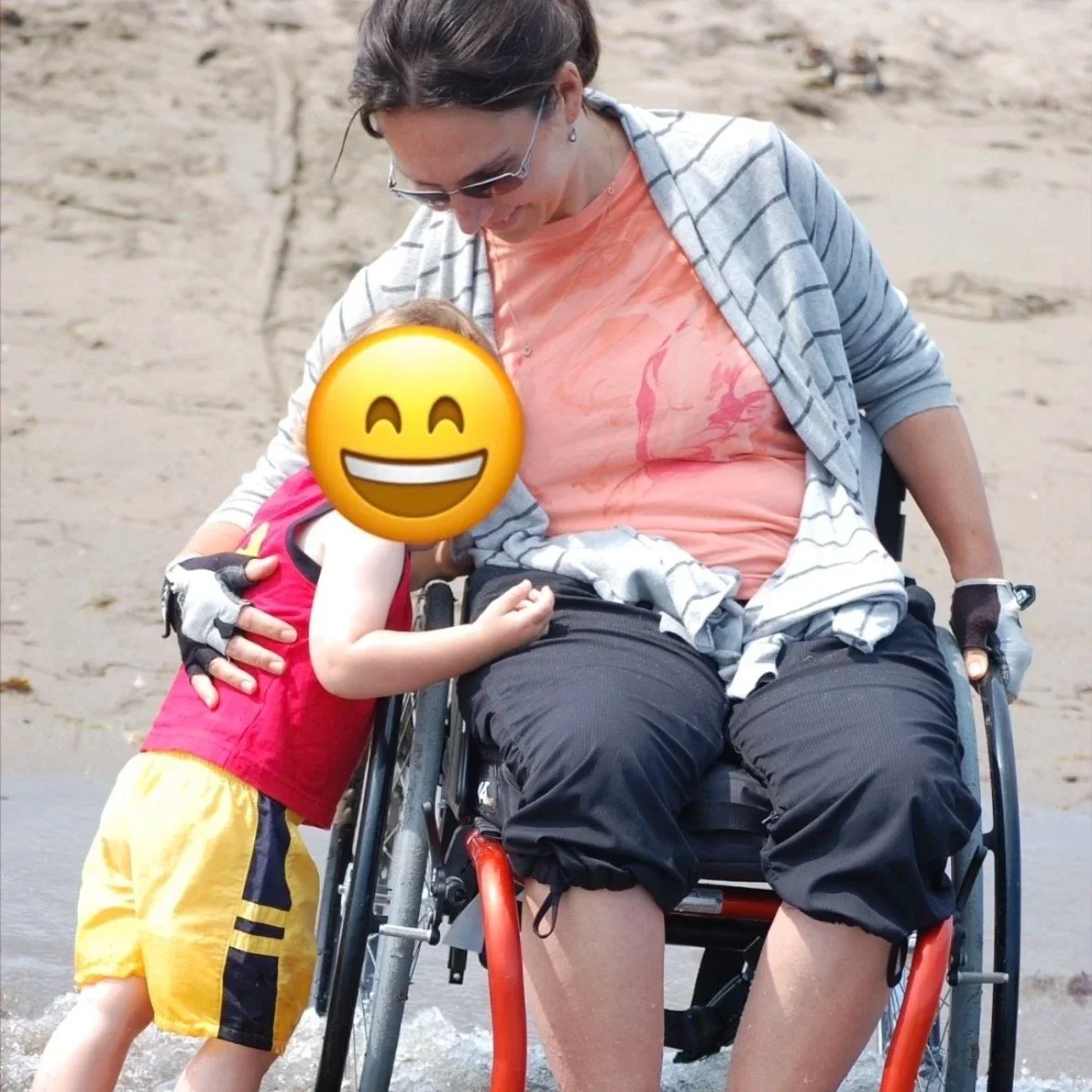
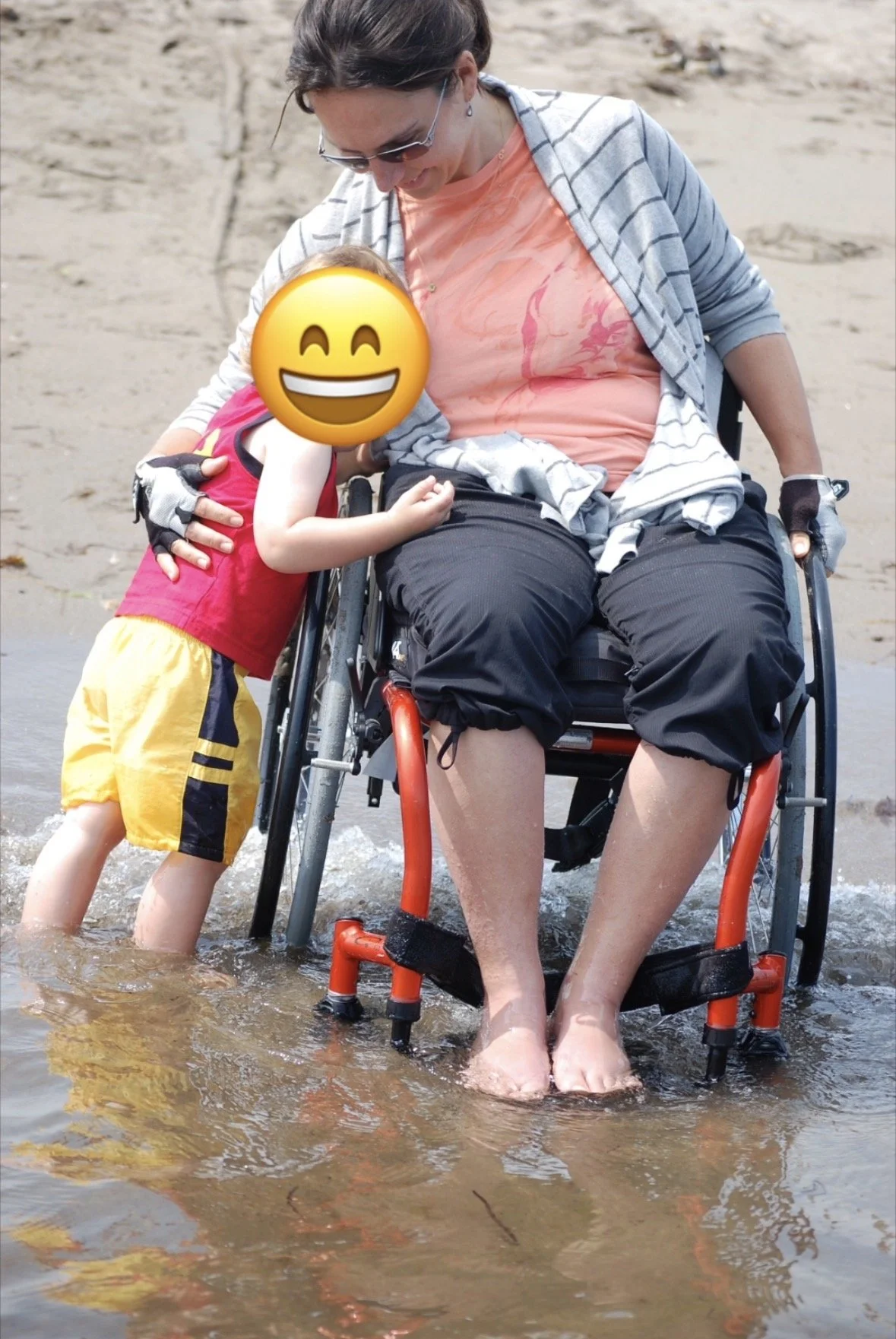
On that first trip as a disabled woman, I swam in the ocean again for the first time, with my toddler son beside me, watching him discover the water. We went to the zoo, and I watched something light up in him that I got to witness firsthand. Both moments taught me something I hadn't fully believed yet: I could still do hard things, and they could still bring me real joy.
Travel affects wellbeing through more than one channel, and that trip handed me a clean example of both: positive emotion — joy and awe — and self-efficacy, the confidence that comes from proving your own competence.
Positive emotion comes in more than one flavor. Joy is the familiar one — feeling good, plainly, in the moment. Barbara Fredrickson's broaden-and-build theory holds that joy does more than feel nice: it momentarily widens what a person notices and believes is possible, and that widening, repeated over time, builds lasting personal resources (Fredrickson, 2001). Awe is joy's more overwhelming cousin — the emotion that arises from encountering something vast, something that doesn't fit into what you already understood (Keltner & Haidt, 2003). The ocean is close to a textbook awe trigger, and tourism research on awe specifically has found it does more than feel remarkable in the moment: it makes people more likely to hold onto the memory afterward, and it deepens their felt connection to the people they shared it with (Lu, Liu, Lai, & Yang, 2017). The swim, the afternoon at the zoo — both were positive emotion doing exactly what it does: widening what I believed was still possible, and tying me closer to my son in the process.
That's echoed in Accessible Journeys magazine's July 2026 issue. Writer Abena Christine Jon'el describes wellness travel as the feeling of her body, spirit, and nervous system slowly coming back into rhythm — meditation, good food, rest, a room that doesn't make her fight for comfort. Another piece in the same issue describes water specifically as one of the simplest, most restorative forms of travel: a mineral spring, a warm pool, a quiet lake at sunrise, sometimes becoming the entire reason for a trip. Neither piece is abstract about it. They're both, plainly, about joy.
The elevator story runs through the second channel entirely. Every barrier worked through becomes evidence of competence — and self-efficacy and self-esteem, built that way, are two of the most consistently documented predictors of wellbeing in the research (Sheu et al., 2020; Zell & Johansson, 2025). The broken elevator didn't just get solved. It became one more piece of evidence feeding that pathway.
Between the ocean and the elevator, that one trip gave me both channels at once. Travel doesn't just feel good, and it doesn't just build confidence. Done right, it does both — and neither one needs the other to matter.
If there's something to take from this:
Don't measure a trip by whether everything worked. Measure it by what you did when something didn't, and what you got to feel when something did.
Learn to advocate before you need to. I learned mine from watching someone else do it under pressure. You don't have to wait for your own emergency to start practicing.
Resources
Accessible Journeys Magazine, July 2026 issue — "Finding Wellness Through Travel": https://accessiblejourneysmagazine.com/aj-july-2026/
References
Fredrickson, B. L. (2001). The role of positive emotions in positive psychology: The broaden-and-build theory of positive emotions. American Psychologist, 56(3), 218–226. https://doi.org/10.1037/0003-066X.56.3.218
Keltner, D., & Haidt, J. (2003). Approaching awe, a moral, spiritual, and aesthetic emotion. Cognition and Emotion, 17(2), 297–314. https://doi.org/10.1080/02699930302297
Lu, D., Liu, Y., Lai, I., & Yang, L. (2017). Awe: An important emotional experience in sustainable tourism. Sustainability, 9(12), 2189. https://doi.org/10.3390/su9122189
Sheu, H., Lent, R. W., Lui, A. M., Wang, X. T., Phrasavath, L., Cho, H., & Morris, T. R. (2020). Meta-analytic path analysis of the social cognitive well-being model: Applicability across life domain, gender, race/ethnicity, and nationality. Journal of Counseling Psychology, 67(6), 680–696. https://doi.org/10.1037/cou0000431
Zell, E., & Johansson, J. S. (2025). The association of self-esteem with health and well-being: A quantitative synthesis of 40 meta-analyses. Social Psychological and Personality Science. https://doi.org/10.1177/19485506241229308

written by
Marjorie Aunos, PhD., is an internationally renowned researcher, adjunct professor, clinical psychologist, and award-winning inspirational speaker from Montreal, Canada.
Recent Blog